Easy Replacement Glass Finder: How to Choose and Measure Fireplace & Stove Glass
How to Find the Right Replacement Glass for Your Fireplace or Stove
A broken fireplace or stove window can look like a simple piece of glass to replace, but ordering the correct replacement requires more than measuring the opening and choosing something that looks similar. The appliance type, original glass material, dimensions, shape, thickness, mounting system, and manufacturer requirements can all affect what you need.
This replacement glass finder walks you through the process step by step. You will learn how to determine whether your appliance uses ceramic or tempered glass, how to measure an intact or missing pane, what to do with curved or unusual shapes, and how to use your stove brand and model number to narrow your search.
Important: Replacement glass should match the requirements of the appliance and its original glazing system. Do not substitute one glass type for another simply because the dimensions match. When available, check the appliance owner's manual, manufacturer's information, original glass specifications, or an existing correctly identified replacement before ordering.
Start With the Appliance, Not the Glass
The easiest way to narrow down a replacement is to first identify what the glass belongs to. A wood stove, pellet stove, coal stove, fireplace insert, factory-built fireplace, and masonry fireplace door system do not necessarily use the same glazing material.
Before measuring anything, write down as much of the following information as you can find:
- Appliance type
- Manufacturer or brand
- Model number
- Serial number, if relevant
- Existing glass dimensions
- Glass thickness, if known
- Whether the glass is rectangular or pattern-cut
- Any markings or identifying information on the original glass
- How the glass is held in the door or frame
The manufacturer and model number can be especially valuable because they may allow you to locate a replacement that has already been identified for that appliance.
If you know your stove manufacturer and model, start with our replacement stove glass by brand section before attempting to create a custom pattern from scratch.
Ceramic Glass vs. Tempered Glass: Why the Difference Matters
One of the most important decisions is determining whether the appliance requires high-temperature glass-ceramic or tempered glass. Although both are commonly called “glass,” they behave very differently when exposed to heat.
What Is Ceramic Fireplace and Stove Glass?
Glass-ceramic used in heating appliances is engineered to tolerate severe temperature changes with very low thermal expansion. This property makes appropriate glass-ceramic products useful for fire-viewing panels in applications where the glazing is exposed to substantially higher heat than conventional architectural or decorative glass.
Ceramic replacement glass is commonly associated with high-temperature heating appliances such as wood, pellet, and coal stoves and many fireplace inserts. The exact material, thickness, dimensions, and installation requirements must still match the appliance.
If your appliance requires this type of material, see our ceramic replacement glass options.
What Is Tempered Glass?
Tempered glass is heat-treated safety glass. The tempering process changes the way the glass behaves mechanically and how it breaks if failure occurs.
Tempered glass can be appropriate for certain fireplace door applications, but that does not make it interchangeable with high-temperature glass-ceramic. Tempered glass should only be selected when it is appropriate for the specific fireplace door or glazing system.
Browse tempered replacement fireplace glass if you have confirmed that tempered glass is what your door system requires.
Can Ceramic and Tempered Glass Be Interchanged?
Do not assume they can.
A common replacement mistake is deciding that ceramic glass must automatically be “better” because it tolerates greater heat exposure, or assuming tempered glass will work because the original pane appears similar.
The glazing is part of the appliance or door system. Changing the material can alter how the assembly responds to heat, how the glass is retained, and whether the replacement matches the manufacturer's intended configuration.
If you are uncertain, identify the appliance and model before ordering. When manufacturer documentation is available, follow its specified replacement-glass requirements.
Quick Replacement Glass Selection Guide
| What You Know | Best Next Step |
|---|---|
| Brand and model number | Search for replacement glass by appliance brand and model. |
| Original glass is intact | Identify the required material and carefully measure the existing panel and mounting area. |
| Original glass is shattered | Use the door, frame, channel, remaining pieces, manufacturer information, or a pattern to establish the required dimensions. |
| Glass has an unusual shape | Record all dimensions needed to reproduce the complete pattern instead of only overall width and height. |
| Unsure whether it is ceramic or tempered | Identify the appliance and original glazing specification before ordering. |
| Unsure about thickness | Verify the original specification rather than guessing from the opening. |
How to Measure Replacement Fireplace or Stove Glass
Accurate measurements are critical with custom-cut glass. A small mistake can result in a panel that does not fit the frame, does not sit correctly against the gasket, or cannot be installed as intended.
Use a rigid metal tape measure or another accurate measuring tool. Record every measurement immediately rather than relying on memory.
If the Original Glass Is Still Intact
An intact original pane can be extremely helpful, but it should not always be treated as the only measurement reference.
Measure the existing glass and compare those dimensions with the mounting area whenever possible. This second check can help identify measurement errors, damaged glass edges, or an old replacement that may not have been sized correctly.
Record:
- Overall width
- Overall height
- Thickness
- Corner shape or radius where applicable
- Notches, arches, angles, or other pattern details
- Location of any special cuts or features
For custom products, follow the measurement instructions shown on the specific product page. Do not automatically alter your measurements unless that product's instructions specifically tell you to do so.
If the Glass Is Broken or Missing
You can often determine the required shape even when the original pane is gone.
Begin by inspecting the door or frame. Look for the channel, gasket line, retaining clips, brackets, or other surfaces that show where the original glass was positioned.
If the opening has an unusual shape, a paper or cardboard template may be useful for documenting the geometry. Trace the mounting area carefully and label the top, bottom, left, and right sides so the orientation remains clear.
Do not assume that the visible opening equals the finished glass dimension. Glass frequently extends beyond the visible opening into a concealed mounting or gasket area.
How to Measure Common Glass Shapes
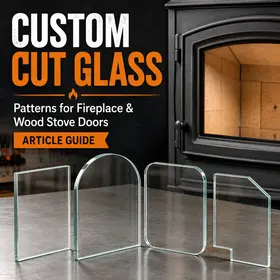
Rectangular glass is usually straightforward. Pattern-cut glass requires additional measurements because overall width and height may not fully describe the shape.
Rectangle or Square
Record the overall width and overall height. Also verify the required thickness and examine the corners for any radius or special treatment.
Round Glass
A round panel is normally defined by its diameter. Measure straight across the center from one edge to the opposite edge. Verify the required thickness and material before ordering.
Arched Glass
An arch may require more than overall width and height. Depending on the shape, measurements can include:
- Overall width
- Overall height at the center
- Height of the straight side before the arch begins
- Additional dimensions needed to reproduce the curve
Glass With Notched Corners
Notched panels require the dimensions of the overall pane as well as the notches themselves. Depending on the design, that can include notch width, notch depth, distance between notches, and their location relative to the edges.
Angled, Gable, or Irregular Glass
Do not try to describe an irregular panel using width and height alone. Measure every straight section and transition needed to accurately establish the shape.
A full-size template may be the safest way to document complex geometry when the ordering process allows one.
Do You Need to Subtract From Your Measurements?
This is one area where generic internet advice can cause problems.
Do not automatically subtract a fixed amount from every measurement unless the instructions for the specific product, appliance, or ordering method tell you to do so.
Required clearance depends on how the panel is mounted and on the specifications of the replacement being ordered. If a custom-glass product page gives explicit measuring instructions, follow those instructions rather than applying a separate universal deduction.
If you are measuring a door or frame because the original pane is missing, confirm whether the requested ordering dimensions should represent the actual finished glass size or the opening size.
Glass Thickness Matters Too
Width and height are not the only dimensions that matter. Ordering the correct thickness is also important.
Do not choose thickness based only on what appears to fit into the opening. The retaining system, clips, gasket, frame, and appliance design may have been engineered around a specific thickness.
If the original glass is available, measure it accurately. If it is not, check the appliance manual, manufacturer information, model-specific replacement listing, or other reliable documentation.
Searching for Replacement Glass by Brand and Model
If you know the manufacturer and model number, searching by appliance is often much easier than trying to reverse-engineer a broken pane.
Fast Replacement Glass offers a glass-by-brand replacement section for wood stoves, pellet stoves, coal stoves, and other supported heating appliances.
Before ordering a model-specific replacement:
- Locate the appliance manufacturer.
- Find the exact model number.
- Compare the model information with the product listing.
- Compare listed dimensions and shape with your appliance whenever possible.
- Verify whether the listing identifies the required glass material and thickness.
- Contact Fast Replacement Glass if the information does not match what you see on your appliance.
Do not rely on the brand name alone. Manufacturers frequently produce many models with different door sizes and glass patterns.
Common Replacement Glass Ordering Mistakes
1. Assuming All Fireplace Glass Is the Same
The phrase “fireplace glass” covers multiple products and applications. Determine the required material before ordering.
2. Ordering From the Visible Opening Size
The glass may extend behind the frame. Measuring only the part you can see can produce a replacement that is too small.
3. Guessing the Thickness
Thickness is part of the replacement specification. Verify it whenever possible.
4. Ignoring Small Pattern Details
Notches, clipped corners, arches, radiused corners, and angled sections can make an otherwise correct panel unusable.
5. Assuming Ceramic Glass Is a Universal Upgrade
Higher heat capability does not automatically make a material appropriate for every door assembly. Match the original glazing requirements.
6. Reusing Damaged Installation Components
While inspecting the glass, also examine the gasket, retaining hardware, clips, channels, and door frame. Damaged or deteriorated components may need attention before the new pane is installed.
7. Tightening Glass Retainers Excessively
Glass should be installed according to the appliance manufacturer's instructions. Do not assume tighter hardware is safer. Incorrect loading or installation can stress the panel.
What to Check Before Ordering
A five-minute review before submitting a custom glass order can save considerably more time afterward.
- Confirm the appliance brand.
- Confirm the exact model number.
- Confirm whether ceramic or tempered glass is required.
- Verify width and height.
- Verify thickness.
- Check every corner and edge.
- Record all arches, angles, or notches.
- Confirm whether your dimensions are finished-glass dimensions or opening measurements.
- Read the measurement instructions on the product page.
- Review all entered dimensions before placing a custom order.
Installation and Safety Considerations
Always work on a completely cool appliance. Broken glass can have extremely sharp edges, so use appropriate hand and eye protection while removing fragments or handling damaged panels.
Replacement procedures vary by appliance. Some doors use clips, retainers, gaskets, channels, or combinations of these components. Follow the appliance manufacturer's installation instructions whenever they are available.
Do not use household window glass as a substitute for heating-appliance glass, and do not change from tempered glass to glass-ceramic—or the reverse—without confirming that the application allows it.
Inspect the gasket and retention system while the door is apart. If a component is damaged, distorted, deteriorated, or missing, determine the correct replacement before operating the appliance.
Frequently Asked Questions About Replacement Fireplace and Stove Glass
How do I know whether I need ceramic or tempered glass?
Start with the appliance type, manufacturer, and model number. Check the owner's manual or original glazing specification whenever possible. Do not select glass solely by appearance because tempered and glass-ceramic products are not interchangeable in every application.
Can I measure the old glass if it is still intact?
Yes. An intact pane is a valuable reference. Measure its width, height, thickness, and any pattern details, then compare those dimensions with the mounting area if possible.
What if the original glass is completely shattered?
Use the frame, mounting channel, gasket location, remaining fragments, appliance documentation, or a model-specific replacement listing to establish the original shape and dimensions. Complex shapes may require a template.
Should I subtract 1/8 inch from my measurements?
Not automatically. Follow the measuring instructions for the specific replacement product or appliance. A universal deduction should not be applied unless the relevant ordering instructions specifically require it.
Can I replace tempered fireplace glass with ceramic glass?
Do not make that substitution based simply on temperature capability. The replacement material should match the requirements of the fireplace door or appliance.
Can I use tempered glass in a wood stove?
Use only the glass material specified for the stove. High-temperature stove applications commonly use glass-ceramic, but the exact replacement specification should be confirmed for the appliance.
How accurate do my measurements need to be?
Custom glass should be measured as accurately as the product's ordering instructions require. Measure more than once and verify all dimensions before submitting the order.
How do I measure an arched or notched glass panel?
Record every dimension needed to reproduce the geometry. Overall width and height may not be sufficient. Arches can require straight-side heights, while notched panels can require notch width, depth, spacing, and location.
Can I search for stove glass using the model number?
Yes. If a model-specific replacement is available, searching by brand and exact model number can be one of the simplest ways to identify the correct pane. Always compare the listing details with your appliance before ordering.
What if I still cannot identify the glass?
Gather the appliance brand, model number, photographs of the door and mounting area, measurements, thickness information, and any remaining pieces of the old glass. Providing complete information makes it much easier to determine the appropriate next step.
Find the Right Replacement Before You Order
The best replacement glass order starts with identification, not guesswork. Determine what appliance you have, confirm the required glass material, measure the panel and mounting system carefully, and document every shape detail before placing an order.
If you already know your stove manufacturer and model, begin with our replacement stove glass by brand. If you need a custom panel, explore custom-cut replacement glass after confirming whether your application requires ceramic or tempered glass.
Taking a few extra minutes to verify the material, dimensions, thickness, and appliance information can make the difference between a replacement that simply looks close and one that is properly selected for the application.
No posts found