What Size Wood Stove Gasket Do I Need? A Complete Measuring & Replacement Guide
How to Identify, Measure, and Choose the Correct Replacement Gasket

Replacing a worn wood stove gasket starts with one important question: what size and style of gasket does your stove actually require? Choosing a replacement by appearance alone can be difficult because an old rope gasket may be flattened, compressed, hardened, or partially deteriorated after years of use.
The best starting point is always the owner's manual or manufacturer information for your specific stove, fireplace insert, or heating appliance. If that information is unavailable or does not clearly identify the gasket, you can often narrow down the correct replacement by examining the existing gasket and carefully measuring the channel where it is installed.
This guide explains how to measure a wood stove door gasket, identify common glass gasket styles, use our printable gasket measuring template, determine how much replacement material you may need, and find the appropriate replacement gasket products.
Why Correct Wood Stove Gasket Size Matters
A new rope-style stove gasket normally has a rounded cross-section before installation. When the stove door closes, the gasket compresses against its mating surface to fill the space between the door and stove body.
Because an older gasket may already be compressed, simply measuring the exposed face of the old material may not tell you its original diameter. Measuring the gasket channel can provide an additional reference when the original specification is unknown.
An incorrectly sized gasket may not seat or compress as intended. For that reason, avoid assuming that a gasket is correct simply because it can physically be pushed into the channel.
Before ordering: check your appliance manual, model information, and existing gasket construction whenever possible. Manufacturer-specific requirements should take priority over a general measuring method.
How to Measure a Wood Stove Door Gasket
If you cannot confirm the original gasket size from the appliance documentation, inspect the old gasket and its channel carefully. A section near a corner or hinge may sometimes be less compressed than the area directly opposite the latch.
1. Examine the Existing Gasket
Look for a section of gasket that has retained as much of its original shape as possible. If you can see an area that is less flattened or worn, use that section as one of your references.
Do not rely on the old gasket measurement alone. Years of compression can make a rope gasket appear significantly smaller or flatter than it was when new.
2. Expose a Small Section of the Gasket Channel
If appropriate for your appliance and installation, gently lift enough of the old gasket from its channel to expose the groove beneath it. Approximately two inches is generally enough to obtain a useful channel measurement.
Use care when working around finished metal surfaces and glass. Follow the appliance manufacturer's instructions whenever they specify a particular removal procedure.
3. Measure the Channel Width
Measure straight across the gasket channel and record the width in inches. Take the measurement from the actual groove rather than from the flattened gasket sitting above it.
4. Clean the Area You Are Measuring
Old gasket cement, adhesive, fibers, and debris may interfere with the measurement. Clean enough of the exposed area to identify the actual bottom and sides of the gasket channel.
5. Measure the Channel Depth
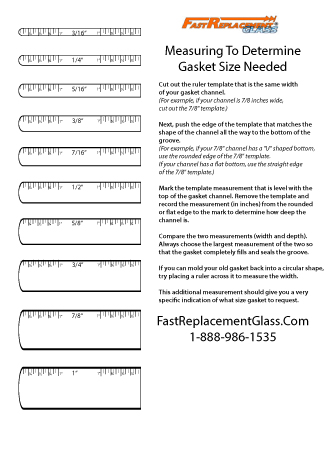
Fast Replacement Glass provides a printable gasket channel measurement template that can help determine channel depth when the groove is difficult to measure with a conventional ruler.
Open the printable gasket measurement PDF.
Important: print the PDF at actual size. Do not use a "fit to page," scaling, or resize option because changing the print scale will also change the measurements on the template.
Using cardstock or another reasonably stiff paper can make the template easier to insert into the gasket channel. Thin printer paper may bend or crinkle before reaching the bottom of the groove.
To use the template:
- Measure the width of your gasket channel.
- Cut out the template section corresponding to that width.
- Determine whether the bottom of the channel is rounded or flat.
- Insert the corresponding end of the template until it reaches the bottom of the groove.
- Mark the point on the template that is level with the top of the channel.
- Remove the template and measure from the end of the template to the mark.
- Record that measurement as the approximate channel depth.
6. Compare Width, Depth, and the Existing Gasket
Once you have the channel width and depth, compare those measurements with the least-compressed section of your old gasket.
If the old rope gasket can be gently returned toward its original rounded shape, measuring across that section may provide another useful reference. The more independent references you have—the appliance manual, old gasket diameter, channel width, and channel depth—the easier it is to avoid choosing a replacement based on guesswork.
The older measuring method recommended comparing channel width and depth and using the larger measurement as a sizing reference. Because gasket requirements vary by appliance design and material, treat this as a general measuring reference rather than a universal manufacturer-specific fitment rule.
Browse wood stove rope gaskets.
How Much Wood Stove Gasket Do You Need?
Once you know the correct gasket type and diameter, determine the required length by measuring the complete path of the gasket channel.
For a rectangular stove door, measure all four sides of the gasket path rather than simply measuring the outside dimensions of the door. For irregular door shapes, follow the actual route the gasket takes.
The original Fast Replacement Glass instructions recommend ordering approximately one additional foot beyond the calculated length to allow for measuring or cutting errors. Confirm the required length and joining method for your particular stove before installation.
Door Gaskets and Glass Gaskets Are Not Always the Same
One of the most common sources of confusion is assuming that every gasket on a stove is ordinary round rope gasket.
The large gasket sealing the stove door to the stove body may use one material and profile, while the ceramic glass may be retained with an entirely different type of gasket.
Stove designs vary, so inspect the glass-retention system and consult the appliance manual before ordering replacement material.
Common Wood Stove Glass Gasket Styles
Several different gasket constructions are commonly found around stove glass. The correct style should be determined from the existing installation, product specifications, or manufacturer documentation.
Fiberglass Rope Gasket
Some stove windows use a relatively small-diameter rope gasket. When a rope gasket is installed in a defined groove, the same channel-measuring approach described above may help identify its approximate size.
The legacy article referenced 3/16-inch, 1/4-inch, and 5/16-inch rope gasket sizes for certain glass applications. Current size availability and fitment should be confirmed before ordering.
Pre-Cut Gasket Kits and Gasket Cement
Some replacement gasket kits combine pre-cut gasket material with adhesive or gasket cement. Whether adhesive should be used—and which type—depends on the appliance and gasket installation.
Do not automatically apply cement simply because the previous gasket appears to have been bonded in place. Check the appliance manufacturer's instructions or the replacement product directions first.
Browse pre-cut wood stove gasket kits.
Flat Glass Gasket or Channel Tape
Flat gasket material may be used around the edge or face of stove glass rather than installed as round rope in a deep channel. It may also be referred to as glass gasket tape or channel-style gasket material depending on the product.
When replacing flat gasket material, identify both the required width and the total length needed to follow the glass or retaining area.
Browse flat wood stove gasket products.
Semi-Rigid Tadpole Gasket
A tadpole-style gasket combines a larger bulb portion with a flatter tail. This distinctive profile makes it very different from ordinary round rope gasket.
If your existing gasket has this shape, match the replacement by construction and required dimensions rather than substituting round rope simply because it appears to have a similar thickness.
View the existing 1/2-inch high-temperature tadpole gasket.
View the existing 5/8-inch high-temperature tadpole gasket.
Soft-Core Tadpole Gasket
Soft-core tadpole gasket uses the same general bulb-and-tail profile but differs in construction from semi-rigid versions. The original gasket or manufacturer specification should determine which type belongs on the appliance.
View the existing soft-core high-temperature tadpole gasket.
Specialty Stove Gaskets and Manufacturer-Specific Applications
Some stove designs use specialty gasket materials that should not be replaced solely according to generic channel measurements.
Vermont Castings Gaskets
The older Fast Replacement Glass information specifically referenced Vermont Castings stove door, glass, and top-loading applications, including an armored or griddle-style gasket.
A previous product page identified a Vermont Castings griddle gasket as a rope-style seal enclosed in stainless-steel mesh. Compatibility should be verified against the exact stove model before ordering rather than assuming one gasket fits every Vermont Castings appliance.
View the existing Vermont Castings griddle gasket product page.
You can also browse the existing filtered gasket selection here:
Browse the existing Vermont Castings gasket selection.
Catalytic Combustor and Interam Gaskets
Catalytic combustor gasket is another specialized gasket material and should not be confused with stove door rope gasket or glass gasket.
The legacy Fast Replacement Glass article describes an Interam-style gasket used around certain round or rectangular catalytic combustors. It listed the material as a slim 1/16-inch wrap containing mica and stated that the material expands when heated. These specifications should be confirmed against the current product listing before publication.
For estimating required length, the legacy instructions used the circumference or perimeter of the combustor:
- Round combustor: determine the required wrap length around the combustor.
- Rectangular combustor: determine the combined length of all four sides.
The original instructions also recommended allowing approximately one additional foot for possible measuring or cutting errors.
Browse catalytic combustor Interam gasket.
Common Gasket Measuring Mistakes to Avoid
Measuring Only the Flattened Old Gasket
An old rope gasket has usually spent years compressed between two surfaces. Its current thickness may not represent the diameter it had when new.
Measuring Over Old Adhesive
Old cement or debris inside a gasket groove can make the channel appear shallower or narrower than it actually is.
Printing the Measuring Template at the Wrong Scale
The printable PDF must remain at its intended scale for its measurements to be useful. Print at actual size rather than scaling the document to fit the page.
Assuming Every Stove Uses Rope Gasket
Glass gasket may be flat, rope-style, tadpole-style, or another manufacturer-specified configuration. Match the construction as well as the dimensions.
Ordering by Stove Brand Alone
A manufacturer may use different gasket systems across different models or production generations. The stove model, gasket location, and existing gasket matter more than the brand name by itself.
Ignoring the Owner's Manual
Measuring is especially useful when specifications cannot be found, but it should not replace reliable manufacturer information when that information is available.
Shop Wood Stove Gaskets by Type
Once you have identified the gasket style and confirmed the measurements, use the Fast Replacement Glass links below to browse the appropriate gasket category.


Frequently Asked Questions About Wood Stove Gasket Size
How do I know what size rope gasket my wood stove needs?
Start with the stove manufacturer's documentation whenever possible. If the original specification is unavailable, examine a less-compressed portion of the existing gasket and measure the width and depth of the gasket channel as additional references.
Can I measure my old stove gasket to determine the replacement size?
You can use the old gasket as one reference, but do not depend on it alone. Rope gasket becomes compressed during use, so its current thickness may be smaller than its original diameter.
Should I measure the gasket or the gasket channel?
When the manufacturer specification is unavailable, both measurements can be useful. Measure the least-compressed portion of the old gasket and the actual width and depth of the cleaned gasket channel.
How do I measure the depth of a stove gasket channel?
Use the printable Fast Replacement Glass measuring template provided above. Print it at actual size, choose the section matching your channel width, and insert the appropriate rounded or flat end into the groove to estimate its depth.
Why must the gasket measuring PDF be printed at actual size?
The template relies on printed dimensions. Scaling the PDF during printing changes those dimensions and can produce an inaccurate measurement.
Are stove door gasket and stove glass gasket the same thing?
Not necessarily. A stove may use round rope gasket around the door while using flat tape, smaller rope, tadpole gasket, or another specified material around the glass.
How much extra gasket should I order?
The legacy Fast Replacement Glass instructions recommend allowing approximately one additional foot beyond the measured requirement to provide room for measuring or cutting error. Confirm this recommendation against the current product instructions before ordering.
What is a tadpole gasket?
Tadpole gasket has a recognizable bulb-and-tail profile rather than a simple round cross-section. If your stove currently uses this style, match the required construction and dimensions rather than automatically substituting rope gasket.
Can I choose a wood stove gasket based only on the stove brand?
No. Different models from the same manufacturer may use different gasket dimensions, profiles, or installation methods. Model-specific documentation should be used whenever available.
Measure Carefully Before Ordering
A replacement stove gasket is a relatively simple component, but choosing the correct one depends on more than finding something that looks close to the old material. Identify where the gasket is used, determine whether it is rope, flat, tadpole, Interam, or another specialty type, and check the appliance documentation before relying on measurements alone.
If the original specification cannot be found, carefully measuring the existing gasket and its channel gives you more information to work with. Use the printable Fast Replacement Glass gasket template when needed, record your measurements before removing the old material completely, and confirm the replacement product requirements before installation.