How to Measure Tempered Glass for Fireplace Doors and Direct-Vent Gas Fireplaces
How to Measure Tempered Glass for Fireplace Doors and Direct-Vent Fireplaces
Replacing tempered fireplace glass starts with more than measuring the width and height. The way the glass is mounted, the shape of the panel, whether an edge is exposed, and whether the glass fits inside a metal frame can all affect what information is needed before ordering a replacement.
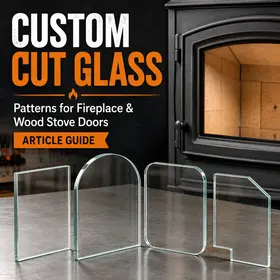
Tempered glass is commonly encountered in applications such as certain fireplace doors and some direct-vent gas fireplace glass assemblies. Fireplace door panels may be rectangular or shaped, including half-arch designs. Direct-vent fireplace glass is typically installed within a surrounding frame with a gasket or sealing material between the glass and frame.
This guide explains how to identify the type of fireplace glass you are measuring, how to measure rectangular and half-arch panels, why polished edges matter on fireplace door glass, and what additional details should be checked before ordering.
First Determine Where the Tempered Glass Is Installed
Before measuring anything, identify how the existing glass is used. Two fireplace applications that may use tempered glass require somewhat different measuring approaches.
Tempered Glass in Fireplace Doors
Traditional fireplace doors often contain individual glass panels mounted inside metal door frames. Depending on the door design, these panels may be:
- Rectangular
- Square
- Half-arch or arched at the top
- Installed as one panel per door
- Installed as multiple panels in folding or bi-fold doors
The shape of the actual glass should be measured rather than estimating its size from the outside dimensions of the fireplace door.
Fireplace door glass can also have an edge that remains visible or exposed after installation. In these applications, the long exposed side of the glass should have a polished finished edge rather than an unfinished cut edge.
Tempered Glass in Direct-Vent Gas Fireplaces
A direct-vent gas fireplace commonly uses a different construction. Instead of individual glass door panels with exposed edges, the viewing glass may be installed inside a metal frame.
The glass sits within the frame, with gasket or sealing material positioned between the glass and the surrounding metal assembly. These glass panels are commonly rectangular.
This distinction is important because measurements taken from the outside of the metal frame are not automatically the dimensions of the glass itself.
If you are replacing glass from this type of assembly, measure the actual glass whenever possible.
Important: Identify the Correct Glass Type Before Ordering
Do not assume that every fireplace uses tempered glass.
Fireplaces, gas appliances, wood stoves, and fireplace doors can use different types of heat-resistant glazing depending on the appliance design. Tempered glass and ceramic fireplace glass are not interchangeable simply because they look similar.
If your existing glass broke into many small pieces, that break pattern can be an indication of tempered glass. Ceramic fireplace glass generally fractures differently and may remain in larger sharp pieces or cracks.
Break pattern can be helpful when identifying the original material, but it should not be the only factor used to select replacement glass.
When possible, check the fireplace or door manufacturer's information, model number, original glass specifications, or other reliable documentation before ordering.
For more information about identifying fireplace glazing, see our guide to fireplace and stove glass types.
How to Measure Rectangular Fireplace Door Glass
If you still have the original glass panel intact, measuring the actual glass is normally the best starting point.
- Remove the glass only when the fireplace is completely cool and the door can be safely serviced.
- Place the glass on a stable, flat surface.
- Measure the width of the glass itself.
- Measure the height of the glass itself.
- Measure the glass thickness.
- Record which edges are exposed when the glass is installed.
- Check whether the exposed long edge requires polishing.
Write measurements down immediately rather than relying on memory.
It is also helpful to take photographs showing the glass, door frame, retaining hardware, and orientation before removing components.
Why the Polished Long Edge Matters
On many fireplace door panels, one long edge is visible after the glass is installed. That exposed edge should have a polished finish.
A polished edge provides a finished appearance and removes the rough appearance associated with a basic cut edge.
When ordering replacement fireplace door glass, identify which long side is exposed and make sure the required edge finishing is included in the order.
This detail is especially important with folding fireplace doors because the orientation of individual panels can determine which edge remains visible.
How to Measure Half-Arch Fireplace Door Glass
Half-arch fireplace glass requires more information than a simple rectangular panel.
The straight lower portion and curved upper portion must reproduce the original shape closely enough to fit the existing fireplace door frame.
At minimum, document the following measurements from the original glass:
- Overall width
- Overall height
- Height of the straight vertical sides before the arch begins
- Glass thickness
- Which edge or edges are exposed and require a finished polish
Do not assume that every fireplace door described as an arch uses exactly the same curve. Two panels can have identical overall width and height but still use different arch profiles.
If the original glass is available, keep it until the replacement has been correctly identified and ordered.
For unusual curved shapes, additional measurements or a physical pattern may be required depending on how the replacement glass is manufactured. Confirm the required information before discarding the original panel.
Measuring Broken Fireplace Door Glass
Measuring becomes more difficult when the original glass has broken.
If enough of the panel remains to reconstruct its original dimensions, carefully determine the original outside width and height rather than measuring an individual broken fragment.
For rectangular fireplace door glass, the surrounding frame can sometimes provide useful information, but the frame opening itself should not automatically be treated as the finished glass size.
The glass normally fits into or behind part of the door structure, which means the actual panel can extend beyond the visible opening.
If a half-arch panel is broken, preserve the remaining pieces whenever it can be done safely. The original pieces may help establish the exact arch profile.
Do not discard the old glass, mounting components, gaskets, clips, or door hardware until the replacement requirements have been determined.
How to Measure Glass in a Direct-Vent Gas Fireplace Frame
Direct-vent gas fireplace glass often appears to be part of one complete framed assembly. The metal frame surrounds the glass, and gasket material or another specified sealing material is positioned between the glass and frame.
Because of this construction, several different measurements can easily be confused:
- Outside dimensions of the complete metal frame
- Visible glass area
- Opening inside the frame
- Actual outside dimensions of the glass panel
These measurements are not necessarily the same.
Measure the Actual Glass When Possible
If the glass can be properly removed from the assembly, measure the actual panel:
- Measure the complete glass width.
- Measure the complete glass height.
- Measure the glass thickness.
- Note the orientation of the panel.
- Document the frame construction.
- Document the location and condition of the gasket or sealing material.
Take photographs before disassembly so the relationship between the glass, gasket, and frame is documented.
Do Not Measure Only the Visible Glass Area
This is one of the easiest measuring mistakes to make.
The portion of glass visible through the fireplace or door opening may be smaller than the actual glass panel because part of the glass extends behind the surrounding frame.
Ordering from the visible opening alone can therefore result in a replacement panel that is too small.
The same principle applies to fireplace door glass. The exposed viewing area is not automatically the complete glass dimension.
Measure Glass Thickness Separately
Width and height are not enough. Glass thickness is another important specification.
If you have the original glass, measure its thickness directly using an appropriate measuring tool.
Do not estimate thickness based on appearance. Small differences can be difficult to identify visually.
If the original glass is missing or too damaged to measure reliably, use the fireplace or fireplace-door manufacturer's specifications whenever available.
Do not substitute a different thickness simply because it fits into the available space without first confirming that it is appropriate for the application.
Check Corners and Shape Carefully
Most rectangular replacement panels have simple corners, but you should still inspect the original glass before ordering.
Look for:
- Square corners
- Rounded corners
- Clipped or modified corners
- Arched sections
- Other custom shaping
Do not assume a panel is a basic rectangle until you have inspected the complete piece.
Tempered Glass Cannot Be Cut After Tempering
One reason accurate measurements matter so much is that tempered glass cannot simply be trimmed to size after the tempering process has been completed.
The cutting, shaping, edge work, and other required fabrication must be completed before the glass is tempered.
That means a panel ordered too large cannot be treated like ordinary window glass and conveniently cut down afterward.
Double-check dimensions, thickness, shape, and required edge finishing before placing the order.
Common Fireplace Glass Measuring Mistakes
Measuring the Door Opening Instead of the Glass
The visible opening is not necessarily the actual panel size. Whenever possible, measure the original glass.
Measuring the Entire Direct-Vent Frame
The dimensions of the surrounding metal frame should not be confused with the dimensions of the glass mounted inside it.
Forgetting Glass Thickness
Width and height alone do not fully describe the replacement panel.
Ignoring the Polished Edge
Fireplace door panels can have an exposed long edge that requires a polished finish. Record this detail before ordering.
Treating Half-Arch Glass as a Simple Rectangle
An arch has its own geometry. Overall width and height alone may not fully define the original shape.
Assuming the Glass Is Tempered
Different fireplaces and heating appliances can require different glazing materials. Identify the correct material before ordering.
Throwing Away the Broken Glass Too Soon
The remaining glass can provide valuable information about dimensions, thickness, shape, edge treatment, and arch profile.
Information to Record Before Ordering
A useful replacement-glass worksheet should include:
| Information | What to Record |
|---|---|
| Application | Fireplace door or direct-vent gas fireplace frame |
| Glass type | Tempered glass only after material has been confirmed |
| Width | Actual outside glass width |
| Height | Actual outside glass height |
| Thickness | Measured original glass thickness |
| Shape | Rectangle, half arch, or other shape |
| Edge finish | Identify exposed edges requiring polishing |
| Frame | Document whether glass sits inside a surrounding metal frame |
| Gasket | Document existing gasket or sealing arrangement |
| Manufacturer information | Brand, model, serial information, or available documentation |
What About the Gasket Around Direct-Vent Fireplace Glass?
If the glass is mounted inside a direct-vent fireplace frame, pay close attention to the existing gasket or sealing arrangement.
The gasket is part of the framed assembly and should not simply be ignored when the glass is removed.
Document where the gasket is located, how it surrounds or contacts the glass, and its condition before disturbing the assembly.
Replacement gasket requirements and installation procedures can vary by appliance. Follow the fireplace manufacturer's requirements for the specific model rather than assuming that a generic gasket or installation method is appropriate.
When Manufacturer Information Is Available, Use It
Custom measuring is useful when replacing fireplace glass, but existing manufacturer information can be equally valuable.
Before ordering, look for a model number or identifying information on the fireplace, fireplace door, frame, or appliance documentation.
If an original part specification is available, compare it against your measurements.
This provides another opportunity to catch a measuring error before custom glass is fabricated.
Frequently Asked Questions About Measuring Tempered Fireplace Glass
Should I measure the fireplace opening or the actual glass?
Measure the actual glass whenever possible. The visible fireplace or door opening may be smaller than the complete glass panel because part of the glass is hidden behind the frame.
How do I measure tempered glass for fireplace doors?
Measure the complete width, complete height, and thickness of the original panel. Also identify the shape and determine which exposed edge requires polishing.
Does fireplace door glass need polished edges?
An exposed long edge on a fireplace door panel should have a polished finished edge. Record the orientation of the panel so the correct edge treatment can be specified.
Can fireplace door glass be half-arch shaped?
Yes. Fireplace door panels can be rectangular or shaped, including half-arch configurations. For an arch, the curve must be documented in addition to the basic width and height.
How do I measure half-arch fireplace glass?
Record the overall width, overall height, straight-side height before the curve begins, thickness, and edge-finishing requirements. Depending on the exact shape and fabrication requirements, additional measurements or a pattern may be necessary.
How do I measure glass in a direct-vent gas fireplace?
When possible, measure the actual glass panel inside the metal frame rather than the outside dimensions of the complete framed assembly. Record width, height, thickness, orientation, and the existing gasket arrangement.
Is the visible glass size the same as the replacement glass size?
Not necessarily. Part of the glass may extend behind the door or fireplace frame, making the actual panel larger than the visible viewing area.
Can I order tempered glass slightly oversized and cut it later?
No. Required cutting, shaping, and edge fabrication must be completed before the tempering process. Finished tempered glass cannot simply be cut down afterward.
Does every fireplace use tempered glass?
No. Fireplace and stove applications can require different types of glazing. Confirm the original material and appliance requirements before ordering replacement glass.
Should I keep my broken fireplace glass?
Yes, when it can be safely retained. Broken pieces may help establish the original dimensions, thickness, shape, corner details, polished edges, or arch profile.
Measure Twice and Document Everything
Ordering replacement tempered fireplace glass is easier when the glass is treated as a fabricated component rather than simply a piece of material with two dimensions.
For fireplace doors, measure the actual glass, record its thickness and shape, and identify the exposed long edge that needs polishing. For half-arch doors, document the curve as well as the overall dimensions.
For direct-vent gas fireplaces, distinguish the actual glass dimensions from the surrounding metal frame and visible viewing area. Document the gasket arrangement and confirm the correct glass specifications for the fireplace before ordering.
A few extra measurements and photographs before placing the order can prevent one of the most frustrating outcomes in replacement glass: receiving a beautifully fabricated piece that is almost—but not quite—the glass you needed.
If you are still determining what type of fireplace glass you have, visit our fireplace glass education resources or browse replacement fireplace glass options before ordering.
No posts found