How to Measure Stove & Fireplace Glass for Replacement
How to Measure Replacement Glass for Wood, Pellet & Gas Appliances
A cracked, chipped, broken, or badly damaged viewing panel does not automatically mean the entire stove or fireplace door needs to be replaced. In many cases, the glass itself can be replaced—but getting the dimensions right is one of the most important parts of the job.
Replacement glass is not something you want to order by eyeballing the opening or rounding a measurement to the nearest convenient fraction. The correct size, shape, thickness, glass material, gasket arrangement, and mounting method all matter.
This guide explains how to measure replacement glass for wood stoves, pellet stoves, fireplace inserts, and other heating appliances, including what to do when the original glass is broken or missing.
If you already know your appliance manufacturer and model number, you may also want to start by checking our replacement stove glass by brand before measuring for a completely custom piece.
Before Measuring: Identify the Appliance
Before reaching for the tape measure, collect as much information about the appliance as possible. This can save considerable time and may help you locate a replacement already listed for your stove.
Look for:
- Manufacturer or brand
- Model name or model number
- Serial number, when available
- Appliance type
- Approximate age of the unit
- Owner's manual or parts diagram
Identification plates are often located on the back, side, inside a door area, or elsewhere on the appliance. Their location varies by manufacturer, so consult the appliance documentation if necessary.
Do not assume two stoves that look nearly identical use the same glass. Manufacturers may change doors, retainers, gaskets, glass dimensions, or other components between models and production runs.
What You Need to Measure Replacement Stove Glass
You do not need an elaborate tool kit, but accuracy matters. Gather your measuring supplies before removing anything from the appliance.
- A reliable tape measure or precision ruler
- Paper or a measuring worksheet
- Pencil or fine-point marker
- Protective gloves for handling damaged glass
- Safety glasses when dealing with broken pieces
- Camera or smartphone for documenting the glass and mounting arrangement
- Paper or cardboard if a template may be required for an unusual shape
When recording dimensions, write them down immediately. Do not rely on remembering several fractional measurements while working around the stove.
Safety First: Work Only on a Completely Cool Appliance
Never attempt to remove or measure stove or fireplace glass while the appliance is hot. Shut the appliance down and allow the door, frame, retainers, glass, and surrounding components to cool completely.
Broken glass can produce sharp edges and small fragments. Wear suitable hand and eye protection and handle damaged pieces carefully.
If the appliance uses gas, electrical components, specialized sealed-glass assemblies, or a door design that you are not qualified to disassemble, consult the appliance manufacturer or an appropriate service professional before proceeding.
Best Method: Measure the Original Glass
If the original glass is intact enough to remove and measure, it is generally the most useful reference for determining replacement dimensions.
After the appliance is completely cool, remove the door or glass only according to the appropriate procedure for your appliance. Retainers, clips, screws, frames, and gasket arrangements vary considerably, so there is no single removal method that applies to every stove or fireplace.
Once removed, place the glass on a stable, flat work surface.
Measure the Width
Measure from one outside edge of the glass to the opposite outside edge. Record the exact width rather than the approximate size of the visible viewing area.
Measure the Height
Measure from the bottom outside edge to the top outside edge. Again, record the actual glass dimension—not the size of the opening visible when the glass is installed.
Measure More Than Once
Repeat both measurements before ordering. For custom-cut replacement glass, Fast Replacement Glass currently requests measurements to be as accurate as possible, within 1/16 inch.
A simple record might look like this:
| Measurement | Your Dimension |
|---|---|
| Overall Width | __________ |
| Overall Height | __________ |
| Thickness | __________ |
| Shape | __________ |
| Brand | __________ |
| Model | __________ |
Do Not Measure Only the Visible Glass Area
One of the easiest mistakes to make is measuring only the portion of glass you can see through the stove door.
The actual glass panel normally extends behind part of the door frame or retaining system. Measuring only the visible opening can therefore produce a replacement that is too small.
Whenever possible, remove and measure the original panel directly.
What If the Original Glass Is Broken?
A broken panel can still provide useful information if enough pieces remain.
If the pieces can be safely arranged on a flat surface, you may be able to reconstruct the original outline and determine its overall width, height, and shape. Do not force damaged pieces together or handle sharp fragments without proper protection.
Take several photographs before disposing of any original pieces. Details that may seem unimportant at first—such as a clipped corner, arch, radius, hole, notch, or beveled area—may become essential when identifying the replacement.
What If the Glass Is Completely Missing?
When the original panel is gone, measuring becomes more involved because the door opening is not necessarily the same size as the glass.
You will need to inspect the area where the glass actually seats behind the frame, including the retaining system and gasket location.
Measure the available glass seating area carefully and document:
- Overall opening width
- Overall opening height
- Available overlap behind the frame
- Gasket location
- Retainer locations
- Corner shape
- Any arches, angles, notches, holes, or other features
Do not automatically order a piece exactly the same size as the metal opening. Heating-appliance glass must be installed with the appropriate clearance and gasket arrangement for that particular application.
Likewise, do not use a generic subtraction formula found online without confirming that it applies to your door. The amount of clearance required depends on the appliance design, glass arrangement, gasket, and manufacturer specifications.
If you no longer have the original glass, contact Fast Replacement Glass with your measurements, photographs, brand, and model information before ordering when there is any uncertainty.
Account for Thermal Expansion and the Gasket
Stove glass should not be forced tightly into a metal frame. Heating and cooling place different stresses on the glass, metal door, retainers, and gasket.
Fast Replacement Glass replacement ceramic-glass listings specify that clearance must be provided for thermal expansion. However, the correct finished dimensions should be determined from the original glass or the requirements of the specific appliance rather than by assuming one deduction works for every stove.
The gasket is equally important. Depending on the appliance, glass may rest against a flat fiberglass gasket or another manufacturer-specified sealing material.
Avoid treating gasket material as a way to compensate for an incorrectly sized panel. The glass, gasket, retainers, and door are intended to work together as a system.
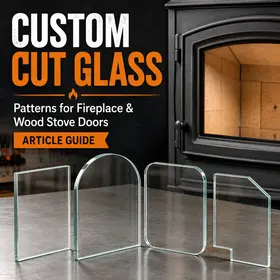
How to Measure Arched Stove Glass
Arched glass requires more information than simple width and height.
Start by recording the maximum overall width and maximum overall height. Then document where the arch begins and the shape of the curve.
Depending on the design, additional measurements or a physical template may be necessary.
Useful information may include:
- Maximum width
- Maximum height
- Height of the straight vertical sides before the arch begins
- Width at the point where the arch starts
- Corner configuration
- Photographs taken straight toward the glass
If an exact replacement is already listed for your manufacturer and model, using the established model-specific replacement may be easier than recreating an unusual shape from measurements.
Measuring Glass With Angled or Clipped Corners
Some stove-door glass looks rectangular at first glance but has small angled corners or other modifications hidden behind the frame.
Record the full width and height first. Then measure each altered corner separately.
Do not assume all four corners are identical unless you verify them.
A clear photograph taken directly above the panel can be extremely useful. Place a ruler or tape measure beside the glass for scale, but make sure the camera is straight above the surface rather than angled, since perspective distortion can make dimensions and corner angles appear different.
Templates for Irregular Replacement Glass
A physical template can be helpful when dealing with unusually shaped stove glass, particularly when the original piece cannot be measured normally.
If a template is requested, reproduce the original glass outline as accurately as possible using suitable paper or cardboard. Clearly identify orientation so there is no confusion about which side is the top, bottom, left, or right.
Before submitting any template for custom fabrication, confirm the required template procedure with Fast Replacement Glass. Specialty shapes may have additional requirements.
Measure or Verify Glass Thickness
Width and height are only part of the identification process. Thickness can also matter.
If you can safely measure the original glass thickness, record it. Better yet, compare your findings with the appliance parts documentation or an existing Fast Replacement Glass listing for the exact model.
Never increase or decrease glass thickness simply because another size is readily available. The replacement must be appropriate for the door and retaining system.
Make Sure You Are Ordering the Correct Glass Material
Not every piece of glass used around a fireplace is the same material.
Wood and Pellet Stove Applications
High-temperature heating appliances commonly use ceramic glass designed for the thermal conditions found in stove applications. Fast Replacement Glass carries ceramic replacement glass for wood, pellet, coal, and related stove applications.
Do not substitute ordinary window glass or another material simply because it can be cut to the same dimensions.
Gas Fireplace Applications
Gas appliances require more caution because glass construction and specifications vary by manufacturer and fireplace design. A gas fireplace may use a different type of glass or a specialized assembly.
Identify the exact appliance and verify the required replacement material before ordering. Do not assume that a material used in a wood stove is automatically correct for a gas fireplace.
Inspect the Gasket and Retainers While the Glass Is Out
Replacement is a good opportunity to inspect the components surrounding the glass.
Look for:
- Flattened or deteriorated glass gasket
- Loose or damaged retainers
- Corroded or damaged mounting hardware
- Warped retaining components
- Debris in the glass seating area
- Damage to the door or frame
If something appears damaged, identify the correct replacement component rather than forcing the new glass into place.
Retaining hardware should secure the glass according to the appliance design without creating unnecessary point pressure on the panel. Follow the appliance manufacturer's instructions for installation and hardware adjustment.
Common Stove Glass Measuring Mistakes
1. Measuring the Door Instead of the Glass
The outside dimensions of the stove door tell you very little about the actual glass size. Measure the original panel whenever possible.
2. Measuring Only What You Can See
Part of the glass is often hidden behind the frame. The visible viewing opening may therefore be smaller than the actual replacement panel.
3. Rounding Measurements
Do not turn a fractional dimension into the nearest whole or half inch because it is easier to remember. Record the actual dimension.
4. Assuming the Opening Equals the Glass Size
If the original glass is missing, the metal opening is only one part of the measurement process. Glass overlap, gasket location, retainers, and required clearance also need to be considered.
5. Using a Generic Clearance Formula
Different stove-door designs can require different sizing considerations. Do not automatically subtract an amount found in an unrelated online guide and assume it applies to your appliance.
6. Ignoring Hidden Corners or Arches
A panel may have clipped corners, radiused corners, or an arch concealed by the door frame. Examine the entire original panel.
7. Forgetting Thickness
A width-and-height match alone does not establish that a piece is appropriate for the appliance.
8. Assuming the Glass Material
Correct dimensions do not make the wrong glass material safe or suitable. Verify the appliance requirements.
Measure Twice Before Ordering Custom Glass
Custom glass is fabricated according to the information supplied with the order. That makes your final measurement review especially important.
Before submitting an order, verify:
- Width
- Height
- Thickness
- Shape
- Corner details
- Appliance brand
- Model number
- Glass material
- Any special features
Then measure the glass again.
It may feel excessive, but a second measurement takes far less time than discovering afterward that a custom-made piece was ordered with the wrong dimensions.
Should You Search by Stove Model or Order Custom Glass?
If you know the appliance make and model, checking for an existing replacement should usually be your first step.
Fast Replacement Glass maintains stove replacement glass organized by brand, including replacement options for many wood, pellet, coal, and insert applications.
A model-specific listing can eliminate some of the uncertainty involved in reproducing an old or broken panel from scratch.
Custom-cut glass becomes especially useful when:
- The original model cannot be identified
- A listed replacement cannot be located
- The appliance uses an unusual panel
- You have an intact original glass piece that can be measured accurately
- You have confirmed the specifications needed for the replacement
Information to Have Ready When Asking for Help
If you are uncertain about the correct replacement, gathering complete information can make identification much easier.
Have the following ready:
- Stove or fireplace brand
- Exact model number
- Serial number if available
- Overall glass width and height
- Glass thickness if known
- Clear front-facing photographs
- Photographs of the door and retaining system
- Photos of any surviving broken glass
- Measurements for arches, clipped corners, or unusual shapes
Good information beats a good guess every time—especially when custom-cut glass is involved.
Frequently Asked Questions About Measuring Replacement Stove Glass
Should I measure the stove opening or the old glass?
Measure the original glass whenever it is available. The visible opening and actual glass dimensions may not be the same because part of the glass can extend behind the frame.
How accurately should I measure replacement stove glass?
Fast Replacement Glass currently asks customers ordering custom ceramic glass to provide measurements as accurately as possible, within 1/16 inch. Recheck every dimension before ordering.
Can I measure broken stove glass?
Possibly. If enough pieces remain and they can be handled safely, the original shape may be reconstructed on a flat surface. Wear appropriate protection and photograph the pieces before disposal.
What if my old stove glass is completely missing?
Measure and photograph the glass seating area, frame, gasket position, and retainers, and identify the appliance brand and model if possible. Do not assume the opening dimension should become the finished glass dimension. Contact Fast Replacement Glass when the required clearance or final dimensions are uncertain.
Should replacement stove glass fit tightly in the frame?
Heating-appliance glass needs the appropriate mounting arrangement and thermal clearance for its application. It should not simply be forced tightly into a metal opening. Follow the requirements for the specific appliance.
How do I measure arched stove glass?
Record the maximum width and height along with the dimensions needed to describe where the arch begins and how the curve is formed. Photos or a template may also be necessary for unusual shapes.
Does stove glass thickness matter?
Yes. Thickness can affect how the panel fits within the door, gasket, and retaining system. Verify the original specification rather than selecting a different thickness simply because the width and height match.
Can I use tempered glass in a wood stove?
Do not substitute glass materials based only on dimensions. Wood and pellet stove applications commonly use high-temperature ceramic glass. The correct material should always be verified for the appliance before ordering.
How do I know what type of glass my gas fireplace needs?
Use the manufacturer, model number, appliance documentation, or verified replacement specifications. Gas fireplace glass requirements can vary, so do not assume the material based on appearance alone.
Should I replace the glass gasket at the same time?
Inspect the existing gasket while the glass is removed. If it is worn, damaged, compressed, or otherwise unsuitable for reuse, identify the correct replacement gasket for the appliance before reassembly.
Get the Measurements Right Before the Glass Is Cut
Accurate replacement glass starts with identifying what was originally installed and measuring it carefully. Whenever possible, use the original panel and appliance information as your primary references rather than estimating from the visible opening.
Record the complete dimensions, inspect the shape and thickness, document unusual corners or arches, verify the correct glass material, and check the surrounding gasket and retaining system.
If you know your appliance manufacturer and model, browse Fast Replacement Glass replacement glass by brand first. If you need a custom piece or cannot identify the original dimensions confidently, gather photographs and measurements before contacting us for assistance.
Measure carefully now, and you are far less likely to have an expensive little “almost fits” problem later.
No posts found