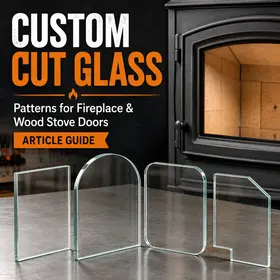
Custom Stove & Fireplace Glass: Holes, Notches, Corners & Edge Finishes
How to Order the Right Shape, Fabrication and Edge for Replacement Glass
Replacement glass is not always a simple rectangle with four straight edges. Some wood stove, fireplace, and insert doors use glass with drilled holes, side notches, radius corners, or other custom features needed to fit the original frame and mounting hardware. At the same time, replacement glass may be offered with several different edge finishes, and choosing an expensive polished edge is not always necessary for a heating appliance.
Understanding these options before ordering can help you reproduce the shape of the original glass more accurately, avoid paying for unnecessary finishing, and—most importantly—make sure the type of glass you select can actually be fabricated the way your application requires.

When Replacement Glass Needs More Than a Straight Cut
Before ordering replacement glass, examine the original panel carefully. In addition to measuring its overall width and height, look for any features that change the basic shape of the glass.
These can include:
- Holes drilled through the glass
- Rectangular or shaped notches along an edge
- Rounded or radius corners
- Special corner cutouts
- Other features required for clips, fasteners, hinges, brackets, or the appliance frame
Do not assume these details can be ignored simply because the replacement panel appears close to the correct overall size. If a notch, hole, or corner profile was part of the original glass, it may have an important role in allowing the panel to sit correctly inside the door or frame.
If you are replacing a broken panel and still have the original pieces, keep them until the replacement has been ordered. The original glass can provide useful information about the dimensions, corner shape, hole location, and notch configuration.
Why the Type of Glass Matters for Holes and Notches

One of the most important questions is whether the replacement panel is high-temperature ceramic glass or tempered glass. These materials are used for different applications and cannot necessarily be fabricated in the same ways.
The source material for these articles specifically identifies custom drilled holes, notches, and radius-corner fabrication as services offered for Pyroceram high-temperature ceramic glass. It also states that Fast Replacement Glass does not alter tempered glass with holes or notches because attempting to cut or drill a tempered panel can cause it to shatter.
That distinction matters when an existing appliance panel has a hole or notch. A customer should not simply order a similarly sized piece of tempered glass and expect to modify it afterward.
If you are uncertain which material your appliance requires, identify that before placing the order. The operating temperatures, appliance design, manufacturer's requirements, and original glass type can all affect the correct choice.
For additional help choosing between heating-appliance glass materials, link readers to a ceramic glass versus tempered glass guide.
Measuring Custom Holes and Notches
Custom fabrication requires more information than the overall width and height of the panel. The fabrication shop must also know where each feature belongs.
A useful measurement record should identify the complete glass size first and then document every custom feature individually.
Start With Overall Glass Dimensions
Measure the original glass itself whenever possible rather than estimating solely from the opening in the door. Record the width and height clearly and identify which dimension is which.
If the original glass is broken or incomplete, additional care may be required to determine the correct finished dimensions. Avoid guessing from fragments when critical portions of the panel are missing.
Document Every Hole
For a drilled hole, the fabrication information may need to identify the hole diameter and its exact location relative to the edges of the glass. If more than one hole is present, each one should be documented separately.
Do not rely on a quick sketch without measurements. A drawing is most useful when the dimensions clearly establish where the center of each hole belongs.
Document Every Notch
Notches can vary in width, depth, shape, and location. Measure from consistent reference edges and make the orientation obvious so the finished panel is not accidentally produced as a mirror image of what you need.
A simple hand drawing can be extremely helpful when it includes:
- Overall glass width and height
- Top, bottom, left, and right orientation
- Notch width
- Notch depth
- Distance from a known corner or edge
- Hole diameter and center location where applicable
- Corner-radius information when applicable
Before ordering a complicated shape, confirm how Fast Replacement Glass currently accepts drawings, templates, photographs, or other fabrication information.
Understanding Replacement Glass Edge Finishes
Custom shape is only one part of the order. You may also encounter different choices for the exposed edge of the glass.
For stove, fireplace, and insert applications, the original articles recommend a seamed edge as the normal practical choice. More decorative polished edges are commonly associated with glass where the edge remains visible, such as shelving or tabletops.

Seamed Edge
A seamed edge is lightly finished to remove the sharp cutting edge. It is a practical choice where the perimeter of the glass will be concealed by the appliance door, frame, retaining system, or gasket.
A seamed edge is not intended to look like a decorative polished furniture-glass edge. Some roughness or minor visual imperfections along the edge may remain.
For many heating-appliance replacements, spending extra money on a decorative edge that will disappear inside the frame provides little practical benefit.
Flat Polish
A flat-polished edge produces a much more finished appearance than a standard seamed edge. The visible edge is ground and polished, with the source material describing small chamfered surfaces along the upper and lower edges.
This type of finish is commonly associated with applications where the glass edge remains visible and contributes to the finished appearance.
Pencil Polish
A pencil-polished edge has a smooth, rounded profile rather than the flatter appearance of a machine-polished edge. It is primarily a decorative finishing choice for applications where the glass perimeter can be seen.
Beveled Edge
A beveled edge creates a wider angled decorative surface around the perimeter of the glass. This treatment is generally chosen for appearance rather than because it is necessary for a stove or fireplace door.
Availability, bevel dimensions, compatible glass types, and current pricing should be confirmed before ordering.
Which Edge Finish Should You Choose for Stove or Fireplace Glass?
If the glass is going into a stove, fireplace, or insert door and its perimeter will be hidden inside the frame, a seamed edge is usually the logical place to start.
Ask yourself three questions:
- Will the edge actually be visible after installation? If not, decorative polishing may provide little benefit.
- Did the original appliance glass use a special decorative edge? If so, document it rather than assuming a standard finish.
- Does the frame or mounting system require a particular edge treatment? If there is any doubt, confirm the appliance requirements before ordering.
The safest buying approach is to reproduce what the appliance actually requires instead of upgrading the glass simply because more finishing options are available.
Do Not Forget the Glass Gasket
The replacement panel is only one part of the door assembly. Many heating appliances use a gasket between the glass and the metal frame or retaining system.
If the existing gasket is damaged, brittle, flattened, missing, or no longer positioned correctly, investigate whether it should be replaced during the glass installation. The correct gasket style and installation procedure depend on the appliance design, so do not assume every stove or fireplace uses the same gasket.
Readers who are also replacing the seal can be directed to a wood stove and fireplace glass gasket guide and the appropriate replacement glass gasket options.
Common Ordering Mistakes to Avoid
Ordering Only by Width and Height
A rectangular dimension does not describe a panel that also includes notches, holes, or special corners. Record every feature that appears on the original glass.
Planning to Drill Tempered Glass Later
Do not order a finished tempered panel with the expectation that holes or notches can simply be added afterward. The supplied source material specifically warns against altering tempered glass this way.
Paying for an Edge You Will Never See
A polished or beveled perimeter may look attractive before installation, but it provides little visual benefit if the entire edge disappears inside the stove or fireplace door.
Guessing at Hole or Notch Locations
Small positioning errors can prevent hardware from lining up correctly. Create a dimensioned drawing rather than relying on memory.
Assuming Every Heating Appliance Uses the Same Glass
Wood stoves, fireplaces, inserts, and other heating appliances can have different glass requirements. Identify the correct material and fabrication requirements for the particular appliance before ordering.
How to Prepare a Custom Replacement Glass Order
Before contacting Fast Replacement Glass about a non-standard panel, gather as much of the following information as possible:
- Appliance manufacturer
- Appliance model information, when available
- Overall glass width and height
- Glass thickness if it can be reliably identified
- Number and location of holes
- Hole diameters
- Notch dimensions and positions
- Corner shape or radius information
- Photographs of the original panel and door
- A dimensioned drawing for unusual shapes
- The type of glass originally used, if known
- The desired edge finish
For standard replacement panels, readers can also be directed to the replacement stove and fireplace glass selection.
Frequently Asked Questions
Can holes be drilled in replacement wood stove glass?
The supplied source information states that custom holes can be fabricated in Pyroceram high-temperature ceramic glass. Current fabrication capabilities, minimum clearances, size limitations, and pricing should be confirmed before ordering.
Can you drill a hole in tempered fireplace glass?
The original material specifically states that Fast Replacement Glass does not drill or notch tempered glass and warns that attempting to alter tempered glass can cause it to shatter.
Can replacement stove glass have notches?
Custom notches may be available for Pyroceram ceramic glass. Provide precise measurements or a dimensioned drawing and confirm current fabrication capabilities before placing the order.
What is a seamed glass edge?
A seamed edge has been treated to remove the sharp cutting edge but is not polished to the decorative finish used on exposed furniture glass. It is commonly suitable when the edge will be concealed inside an appliance frame.
Do I need a polished edge on wood stove glass?
Not necessarily. If the glass perimeter is hidden once installed, the original articles recommend a standard seamed edge rather than paying for decorative finishing that will not be visible.
What is the difference between flat polish and pencil polish?
Flat polishing creates a flatter finished perimeter, while pencil polishing creates a smoother rounded profile. Both are more decorative than a basic seamed edge.
Should I copy the shape of my original glass exactly?
Original holes, notches, corner shapes, and dimensions should be documented carefully because they may relate to the way the panel fits the door or mounting hardware. Do not intentionally eliminate an original feature without confirming that it is unnecessary.
What if I do not know whether I need ceramic or tempered glass?
Identify the appliance and original glass requirements before ordering. Fast Replacement Glass can help customers determine the appropriate replacement option when sufficient appliance and glass information is available.
Get the Shape and Finish Right Before Ordering
Custom replacement glass becomes much easier when the order is broken into three separate questions: What material does the appliance require? What exact shape must the replacement panel have? What edge finish is actually necessary?
For many heating applications, the answer may be high-temperature ceramic glass fabricated to reproduce the original holes, notches, or corners, with a practical seamed perimeter hidden inside the door frame. More decorative edge finishes are available for situations where appearance matters, but they should be selected for a reason rather than added automatically.
If your original panel has an unusual shape or you are unsure how to document it, contact Fast Replacement Glass before ordering. A few careful measurements and photographs can prevent a surprisingly expensive piece of glass from becoming an equally impressive paperweight.
No posts found